_edited.png)
The Anatomy of Helplessness: Time and Capital in "Unspoken"
- Richard Caeiro

- Jan 21
- 3 min read
By Richard Caeiro

There are films that do not just tell a story, but inhabit the open wound of a generation. "Unspoken" (À demi Maux), by director Sai Ko Mimeur, is a visceral dive into the static electricity hovering between two beings who love each other, yet were disfigured by the urgency of a world that does not forgive doubt.
Through the relationship between Chris and Eva, the film transcends family drama to become a cartography of silence and a manifesto on human fragility in the face of collapsing promises of the future. We are not facing a simple conflict of cohabitation, but an internal exile where the soul is the commodity at risk.

The narrative, structured in temporal flows and ebbs, operates like the mechanism of a traumatic memory desperately trying to organize the shards of the past to give meaning to a present in ruins. Chris, at 21, personifies the height of capitalist anxiety. His anguish does not spring from nothing; it is the fruit of constant comparison, of an invisible race where he feels tragically behind. Looking at friends who "already know what they want," Chris sees not just careers or plans, but a flow of efficiency from which he feels excluded. In the current system, not having a destination is read as a failure of the self, and this self-demand transforms into a rage he unleashes on the only person he still recognizes as authority: his sister.

Eva, however, is the materialization of what happens when the engine stalls. Her disappearance, marked by depression and the emotional slaughter of an academic life that demands performance over knowledge, was an act of silent sabotage. She did not abandon Chris; she withdrew from a game where the rules were predatory. When she returns, she brings with her the fissures of one who discovered that, sometimes, "selfishness" is the only form of self-preservation possible. By admitting she needed to flee, she exposes the truth society tries to hide: in a world that consumes us to the bone, disappearing is a form of resistance. Chris, in confronting her, demands a "compass" she does not possess, revealing how we project onto others the responsibility to save us from a desert that is collective.

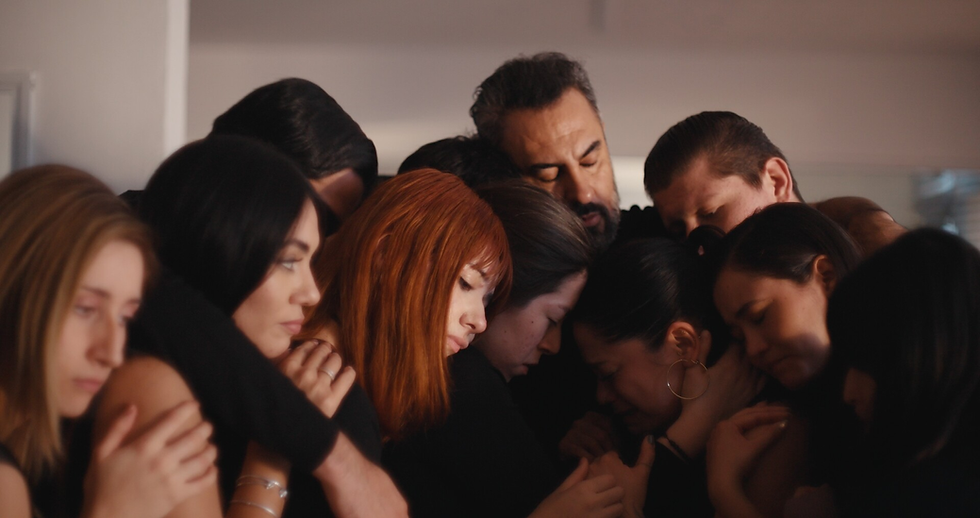
Psychologically, the two are "blood brothers in shared trouble," mirroring each other in a dynamic of crossed abysses. Chris's aggressiveness is the cry of one wanting to be cared for; Eva's silence is the exhaustion of one who has nothing left to offer. The image in "Unspoken" summons us to a metamorphosis: we cease to be judges of these siblings' morality to inhabit the precarity of their existence. The film attacks us by showing that affection, under economic and social pressure, becomes a war zone where fragility is punished with guilt.
The film reaches its highest note of subversion when Chris accepts Eva's "selfishness." In that instant, the film attacks the liberal logic of unconditional sacrifice. They recognize that, to avoid losing themselves entirely, they needed, at different moments, to leave the race. It is the recognition that mental health is not a luxury, but the territory where the final battle against alienation is fought. Chris's anxiety is not resolved with a career plan, but with the validation that he has the right not to know. Eva's depression is not cured with a return to normalcy, but with the acceptance that normalcy was, itself, the source of the pain.

To universalize "Unspoken" is to understand that Chris and Eva are in every café in Paris, at every counter in Rio de Janeiro, or in any metropolis where time has been hijacked by productivity. Sai Ko Mimeur's work reminds us that the "unspoken" between the siblings is the background noise of a society that has forgotten how to listen to fragility.
The forgiveness between them is not a bourgeois "happy ending," but a pact of clandestine brotherhood. It is the decision that if the world outside is a meat-grinder, the space between two siblings must be sacred ground where doubt is permitted and exhaustion is welcomed.

Philosophically, the film places us before the finitude of our certainties. In the end, Chris and Eva do not emerge with answers, but with something far more valuable in today's world: company in helplessness. Cinema here ceases to be entertainment to be a mirror of a youth inhabiting the fissures of a failed system. "Unspoken" ends, but the dialogue it initiates in the viewer remains as an uncomfortable reminder that affection is the only currency that does not devalue when everything else seems to crumble. It is a dense, necessary, and deeply human work about the courage to stop in a world that demands we run until we fall.


Comments