_edited.png)
The Relief of Absence: Transfigured Light in "Scáth"
- Richard Caeiro
- Jan 27
- 3 min read
By Richard Caeiro

Some works aren't meant to be watched; instead, we simply inhabit their intervals. "Scáth" (Shadow), by Irish director Chris McKenna, is one of those rare moments where cinema shifts from representation to a phenomenology of the spirit. McKenna, whose hands helped sculpt the textures of monumental productions like Dune: Part Two, here subverts his technique in favor of a devastating intimacy. The film is a visual testament born from real grief over the loss of a close friend, transforming private pain into a universal cartography of persistence.

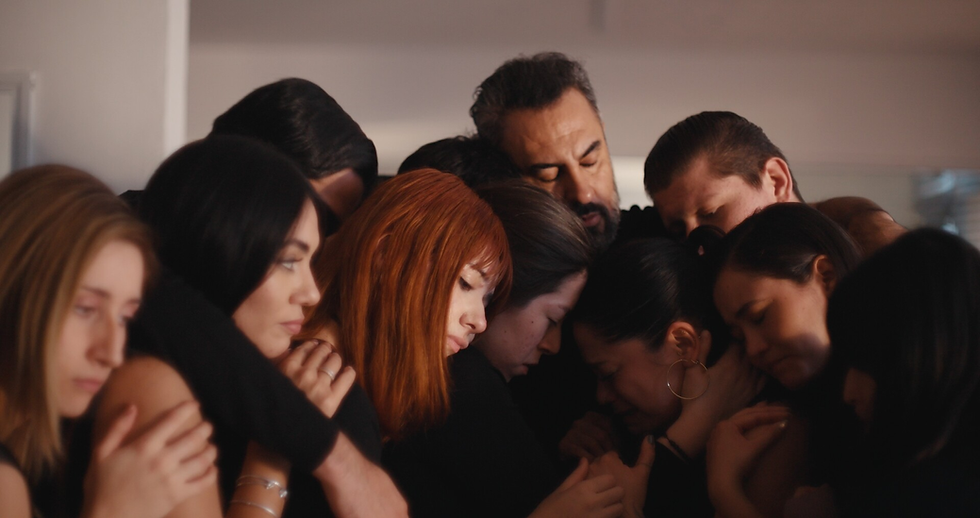
What McKenna proposes in "Scáth" is a struggle between the weight of wood and the volatility of light. Through interiors immersed in shades of ochre, amber, and brown—bars and spaces that seem caught in a time capsule—the director creates a psychological refuge where the past still pulses at a low frequency. This comfort, however, is constantly challenged by the gray rawness of the fields and the muteness of graveyards. Philosophically, the film defies the concept of death as a full stop, presenting it instead as a "metamorphosis of presence." The shadow (Scáth) ceases to be a void and becomes physical proof that the beloved object still stands before the light, projecting its form onto the present.

The psychology of the work understands that grief is not a path to be traveled, but a territory to be recognized. The photography treats every frame as a painting of light and shadow, where contrast serves truth rather than drama: loss brings a flicker of danger even to what is most familiar to us. Yet, "Scáth" refuses easy nihilism. It shows us that in the gaps where love once resided, something sacred survives—a flame vibrating in the gloom, refusing to be extinguished. It is a story about echoes, about the realization that in the shadow, we finally begin to see the outline of that which never truly left us. A film of painful and essential beauty.

At the heart of "Scáth" lies a fragmented character, someone who refuses to accept the absolute silence that death attempts to impose. By filming the conversations between the man who remains and the friend who has passed, Chris McKenna touches on a zone of ambiguity that is the most fertile territory of grief. For the spiritually inclined viewer, these dialogues are proof of a supernatural encounter, a tearing of the veil where love proves stronger than the biological barrier. For the skeptic or the rationalist, it is a psychological projection, a construct of the mind seeking protection against emotional collapse within a delusion.
However, for McKenna’s cinema, this distinction is irrelevant. What matters is the truth of the sensation.

Philosophically, the film approaches the idea that the "other" is never just a body, but a constellation of memories that lives within us. When the protagonist talks to the absence, he is performing a ritual of maintaining his own identity. If the "self" is shaped by the "other," losing a friend is losing a part of oneself. Therefore, the dialogue is not madness or a ghostly visit; it is a desperate attempt to keep the world cohesive. The amber light and ochre tones that bathe these scenes provide a "daydream" texture, where the boundary between what is real and what is felt dissolves.

The beauty of "Scáth" lies precisely in not offering a diagnosis. McKenna doesn't film a ghost; he films the presence of absence. For the viewer, the sovereign doubt remains: are we witnessing a miracle of the soul or the architecture of pain? In the end, the film suggests that perhaps these two things are the same. Spirituality and psychology are just different names we give to our inability to say goodbye. What remains is the Scáth—the shadow—sitting there at the table, proving that no one truly leaves as long as there is someone willing to sustain the conversation.


Comments